Each of Dan’s books below can be purchased through NAEYC or Redleaf Press. Purchase is possible through other booksellers as well. Dan’s most recent book is
Education for a Civil Society: Teaching Young Children to Gain Five Democratic Life Skills
Guidance for Every Child: Teaching Young Children to Manage Conflict
Tying together the theory and practice of child guidance and behavior in clear and accessible ways, this book provides educators and caregivers actionable best practices to teach children healthy emotional and social development. Using contemporary brain research, vignettes, and discussion questions, this book gives you the tools and strategies to reduce the increasing expulsion rate in early childhood, understand how stress affects children’s self-regulation, and help even the most at-risk children thrive.
A great strategy to help reduce the increasing expulsion rate, Dan Gartrell’s guidance practices teach children to express strong feelings well, solve problems in creative ways, accept differences, and think ethically and intelligently. Use this book to empower children and never give up on any child.
A Guidance Guide for Early Childhood Leaders
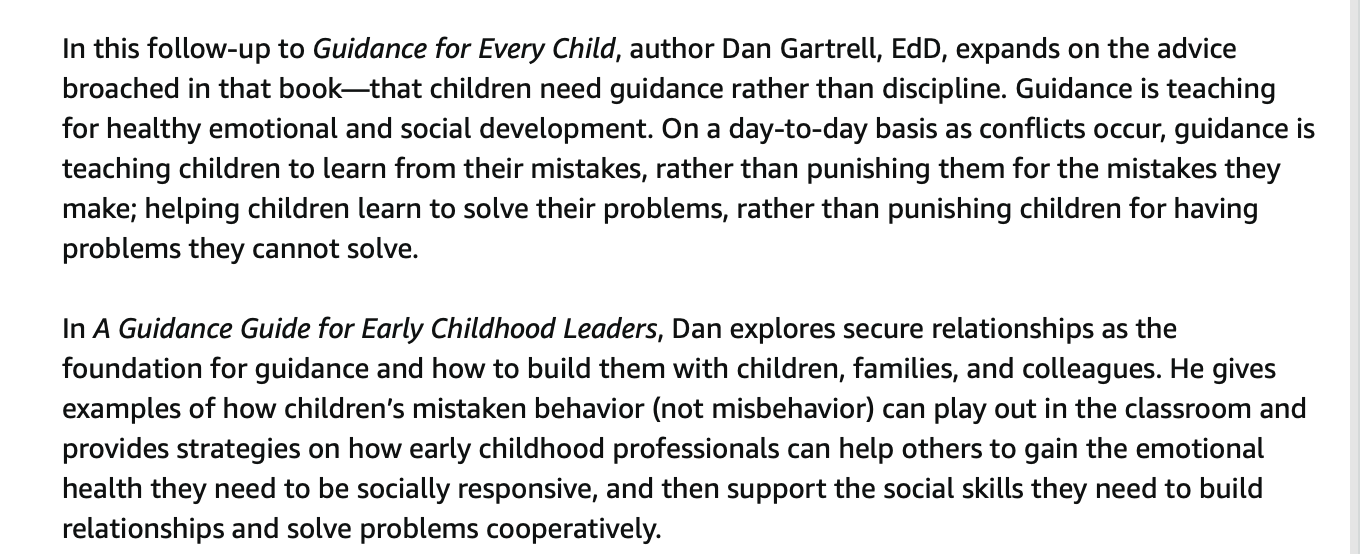
A Guidance Approach for the Encouraging Classroom
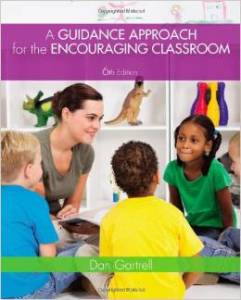
Addressing ages 3 to 8 years, A GUIDANCE APPROACH FOR THE ENCOURAGING CLASSROOM, 6th Edition, functions as a primary reference for professionals or as a resource for classes that address group management, the learning environment, child guidance, child behavior, challenging behavior, conflict management, and peace education topics. Part 1 explores the foundation of guidance in early childhood education. Part 2 focuses on building and organizing an encouraging classroom, and discusses such topics as daily schedules, routines, use of thematic instruction, and the importance of working with parents. Part 3 addresses problem-solving and challenging behavior, including a practical illustration of how to use and teach conflict management and information about the “five-finger-formula.” Highlights of the new edition include standards and video integration, expanded coverage of diversity, and information on current brain research. Throughout, this experience-based resource includes real-life anecdotes that allow professionals to make the shift from conventional classroom to developmentally appropriate guidance.
The Power of Guidance: Teaching Social-Emotional Skills in Early Childhood Classrooms
The Power of Guidance: Teaching Social-Emotional Skills In the Early Childhood Classroom has the distinction of being selected as a 2003 comprehensive member benefit by the NAEYC, an honor for any author in the field. It is a collection of well-received writings on how to use guidance in early childhood classrooms. The material teaches strategies for developing an encouraging classroom and for working with children, particularly boys, who have moderate and serious conflicts. It also presents non-punitive approaches to classroom management. Those who will find the most value in this compilation of material on guidance are practitioners in the field, including Head Start teachers, childcare teachers, and preschool and primary grade teachers and assistants. The Power of Guidance: Teaching Social-Emotional Skills In the Early Childhood Classroom also will be popular in training programs for staff pursuing Child Developmental Associate credentials and other early childcare training certificates.
Education for a Civil Society: First Edition
This book is out-of-print and has been replaced by the completely rewritten second edition, Education for a Civil Society: Teaching Young Children to Gain Five Democratic Life Skills.
What the Kids Said Today: Using Classroom Conversations to Become a Better Teacher
The great privilege of teaching is that you, the teacher, learn something new from the kids every day. “In fact,” writes author Dan Gartrell, “the freshness of life lessons that young children teach keeps many teachers rejuvenated, and committed to the field.” You can have years of experience, and you can own all of the latest textbooks. But you still need to keep your eyes and ears tuned to the greatest teachers of all—the children in your classroom.
Written for present and future early childhood teachers by present and future early childhood teachers, What the Kids Said Today looks directly and openly at how teachers and young children talk with each other in the classroom. A good teacher, Gartrell states, uses these conversations to build what he calls the encouraging classroom, a community where mutual acceptance is the priority and where children can learn the skills they’ll need in larger communities in the future. Skills that include acceptance and cooperation, creative and peaceful problem-solving, and ways to express emotions that are acceptable to all.
The author collected 160 stories from more than 60 adults at Head Start, child care centers, family child care homes, and kindergarten classrooms—including anecdotes from beginning student teachers and from experienced directors. Each story includes an account of a teacher’s conversation with children, as well as reflections on how each conversation can help build an encouraging classroom. Discussion questions at the end of each chapter help foster further exploration of what kids say to their teacher and what a teacher says to them.
This book is out of print. Contact Dan at gartrell@paulbunyan.net for a copy
 Dan Gartrell Ed.D.